
Accessibility Communications
Admin Generals
May 7, 2025
MSU Billings takes pride in serving all of our students in the very best way we can, regardless of their backgrounds, their life stories, or their varying abilities. It's not only our mission, it's the right thing to do.
Coming next year, there will be new standards in place that ensure our website and digital content are measuring up to our aspirations.
In 2024, the Department of Justice updated regulations in Title II of the Americans with Disabilities Act (ADA), requiring that state and local government institutions must ensure all websites and digital content meet WCAG 2.1 Level AA accessibility standards. MSUB has already begun taking action to meet the April 2026 deadline.
An ADA Website Compliance Committee at MSU Billings has been formed to ensure accessibility is being addressed across both campuses and is considering the possibility of investing in accessibility software and training.
In the months to come, we will be auditing the site to identify accessibility issues, giving priority to high-traffic pages and critical student services. Though UCAM’s Web Best Practices have been in place for nearly five years, there is still a great deal of remediation to be done for older materials and newer content that did not fully address things such as image alt text, self-descriptive links, and accessible PDF files. What we learn will be shared and we'll work to find ways to provide training as best as we can.
Making our digital services, programs, and activities accessible may feel daunting. But it is helpful to remember that taking time for things like video captions is not only removing barriers for people with disabilities, they are also benefiting everyone.
Like other colleges and universities, our work on this project this will be checked. Failure to comply with these stricter requirements could result in legal consequences, fines, and loss of federal funding, but that’s not why we’re doing it: MSUB’s mission to educate students from diverse backgrounds will motivate our actions.
If you are interested in learning more about the new regulations, please visit Fact Sheet: New Rule on the Accessibility of Web Content and Mobile Apps Provided by State and Local Governments.
For technical-specific questions, please contact Steve Miller or Cara Virostko. For general questions (or to generally vent), feel free to contact me.
Have a great day.
Dan Carter
Director
University Communications & Marketing
December 8, 2025
While colleges and universities around the country are racing headlong in a race to adopt emerging technologies, an equally crucial aspect of our work is drawing attention: Ensuring websites are accessible to all users.
Starting next April, there will be new Department of Justice standards in place that requires our website and digital content are measuring up to our aspirations.
In 2024, the Department of Justice updated regulations in Title II of the Americans with Disabilities Act (ADA), requiring that state and local government institutions must ensure all websites and digital content meet WCAG 2.1 Level AA accessibility standards. MSUB has already begun taking action to meet the April 2026 deadline.
Since providing an update on this topic in May, an ADA Website Compliance Committee here at MSU Billings has been working on the topic. Members of that cross functional team through the past few months have contributed to our discussions and ongoing planning. They are:
- Steve Miller, Web/Digital Content Manager with UCAM
- Cara Virostko, Program Coordinator/Webmaster with UCAM
- Andrea Aebersold, Director, Center for Teaching and Learning
- Tyr Hawkaluk, Instructional Designer at CTL
- Suzette Nynas, Athletic Training Program Director and Faculty Senate Chair
- Tracy McLuskie, Director, Disability Support Services
- Greg Gerard, CC DSS Coordinator, Disability Support Services
- Nathan Sonnenschein, User Services & Experience Librarian, MSU Billings Library
- Amber West Martin, Director, Academic Support Center
- Hollie West, Director of Marketing, MSUB Athletics
- (We are always looking for willing participants on this group. If you or someone on your team needs to be a part of it, please let me know.)
Updates since May include:
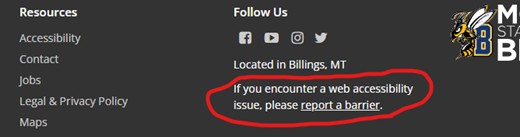
- Development of a web barrier reporting tool that lives at the footer of each web page and shown in the image above. Any user of our website (students, parents, community members, etc.) who encounters a web accessibility barrier, is welcome to report the issue, and someone from our team will follow up with them. The "Report a Barrier" form is on the University Communications & Marketing web page.
- Incorporation of best practices on developing course materials that can be utilized by faculty and staff in Canvas. Tyr is a good resource for anyone who needs help and you can find some good guidance and other resources through the Center for Teaching and Learning.
- Review and validation of best practices with library resources, especially third-party vendors (journals, research materials, etc.) that faculty or students use.
- Continuing conversation with MSU colleagues on how website accessibility will be reviewed and checked on development of web pages when the new web Content Management System (CMS) is rolled out in early 2026. There is no certain date yet when migration will happen of our materials to a new CMS, but we will keep you all informed.
- Ongoing review of PDFs on the MSU Billings website (there are about 10,000) and helping users understand what may be out of compliance with the new rules and what options are in place if those PDFs need to be moved, deleted or redone. We also help others understand best practices when developing new documents or web pages. (For example, would your information be more accessible as part of a web page as opposed to a PDF?) That is not to say that PDFs are inherently evil, but they off present accessibility problems that many people don't realize. The below decision tree might help you when deciding what to do if you happen to discover old PDFs on your public-facing web page. It is also attached.
I have an old PDF File. What should I do with it?
UCAM’s Web Best Practices offers great advice on developing new pages or remediating older materials that did not fully address things such as image alt text, self-descriptive links, and accessible PDF files.
Making our digital services, programs, and activities accessible may feel daunting. But it is helpful to remember that taking time for things like video captions is not only removing barriers for people with disabilities who are currently looking at our web pages, but it is a proactive measure for future users. MSUB’s mission to educate students from diverse backgrounds motivates our actions and keeps us focused.
If you are interested in learning more about the new regulations, please visit Fact Sheet: New Rule on the Accessibility of Web Content and Mobile Apps Provided by State and Local Governments. The Chronicle of Higher Education also recently had a panel discussion that you can watch to get a national perspective of what is happening. The panelists included experts from the University of Washington, Iowa State University, and the University of Louisville.
The MSU Billings team is keeping an eye on developments as they occur. For technical-specific questions, please contact Steve, Cara or Tyr. For general questions (or to generally vent), feel free to contact me.
Have a great day.
Dan Carter
Director
University Communications & Marketing
April 10, 2026
MSU Billings takes pride in serving all of our students in the very best way we can, regardless of their backgrounds, their life stories, or their varying abilities. It's not only our mission; it's the right thing to do. And it includes all ways in which they access our services, whether online or in person.
As many of you know, new federal standards will be in place this month that help us ensure our website and digital content are measuring up to our aspirations. Updated regulations in Title II of the Americans with Disabilities Act (ADA), now require that state and local government institutions must ensure all websites and digital content meet WCAG 2.1 Level AA accessibility standards. The federal deadline for compliance has been set for April 24, 2026.
Please understand that this is not just a Disability Support Services issue. Responsibility for compliance rests with all of us who put content online or in emails that can be shared with the public. So MSU Billings formed a cross-functional committee that worked to understand the challenges and provide guidance. The first meeting was in May 2025. We have had several meetings and offered a variety of training since that time as well as provided a few general communications.
Our goal as a university task force has always been to show progress, not perfection. With a website that has thousands of pages with thousands of PDFs, we know there is not enough time or personnel to remediate everything, but we are making strides. But like cybersecurity, attention to accessibility issues is a constant endeavor.
This communication is designed to give you an update on what's been done so far, what is ongoing, and provide some contacts for further questions.
What's been done so far?
- Development of a web barrier reporting tool that lives at the footer of each web page and shown in the image above. Any user of our website (students, parents, community members, etc.) who encounters a web accessibility barrier, is welcome to Report a Barrier and someone will follow up with them.
- Incorporation of best practices on developing course materials that can be utilized by faculty and staff in Canvas via the Center for Teaching and Learning. Tyr and Andrea continue to do workshops and put resources at the Center for Teaching and Learning site.
- Across the university, staff have reviewed compliance that may involve third-party vendors. That exercise is an ongoing effort, but we are happy to report that compliance has been confirmed for:
- Athletics
- Housing and Residence Life
- GradLeaders, which provides the platform for CareerLink.
- ACE Ware, which handles registration for non-credit classes.
- MSU Billings Library, specifically for research guides and the library catalog
- The Business Office has taken various steps for updates on its pages, but the largest lift was taking previously inaccessible tuition and fee PDFs from OCHE and turning them into the MSUB Tuition & Fee Chart webpage.
- Several departments have archived some PDFs that were on their web section and remediated others.
- Conversations have continued with MSU colleagues on how website accessibility will be reviewed and checked on development of web pages when the new web Content Management System (CMS) comes online.
- Ongoing review of PDFs on the MSU Billings website (there are about 10,000). Many users face a decision when they find a PDF in their web sections. The PDF Files decision tree might help you when deciding what to do if you happen to discover old PDFs on your public-facing web page.
- An Accessibility and PDFs Training has been prepared for our YouTube channel along with its transcript.
FAQs
Q: What happens on April 25 if not all our pages are 100% accessible as deemed by the federal government?
A: Don't worry. Our website — or your web pages — will not be shut down. The attention to this is to ensure we have processes and procedures in place to address concerns/complaints that come up. It is being taken seriously at all levels of the university and that will continue.
Q: My staff tried to remediate some PDFs but we have so many. What do we do?
A: You do the best you can. The MSU Billings Web Best Practices section has a link to how to handle PDF files, including a decision tree that guides how best to handle what you might have on your site. Decisions on what to keep on your websites are up to individual departments. The key is to look at the deadline as a time to turn the page and start making all our pages and embedded documents accessible by design. Cara Virostko can help with that.
Q: What do I do if I get a website accessibility complaint?
A: First thing you do is not panic. The second thing you do is point the person to the web accessibility barrier link in the footer of each web page. If that person is unable to use that form, you can help them fill out the form or they can contact Web Manager Steve Miller via telephone at 406-247-5777. People in general are willing to work with entities when they have a thoughtful process in place to handle their concerns. Trouble starts and complaints are filed with the Office of Civil Rights when we don't have a system in place to address those concerns.
Q: Does Docusign meet accessibilty standards?
A: Docusign is a tool that is as accessible as the PDFs that are uploaded to it. As experts in Docusign point out, the person who creates the document is responsible for making sure it is accessible before uploading it to Docusign. Best practice is to make documents accessible from moment of creation as a Word document. Review Ensuring Accessible Signing and Sending Experiences for more information.
Q: How do I know if I am responsible for any of this?
A: There are CMS users assigned to every web section. Check with webmaster@msubillings.edu or your department if you might be one of them. For faculty or instructors, they are responsible for making content accessible in their own courses.
Q: What is OCHE's guidance on this topic?
A: The OCHE team views accessibility as a shared responsibility. Please refer to the overview attached.
Where do I go for resources?
- If you are looking for a good primer on the importance of uniform accessibility in the internet page, check out the good article from the Center for Teaching and Learning.
- If anyone — faculty or staff — needs access to a license for Adobe Acrobat, contact the Service Desk.
- If you need more information about building a strong page from start, check out the Web Best Practices page via the Accessibility link.
A lot of great work has been done on this project to this point. But like making sure that ALL needs of ALL students are met, the work is never done. Together, we are making progress. And together, we will continue to do so.
Thank you for all you do.
Dan Carter
Director
University Communications & Marketing