
University Communications and Marketing
MSUB art professor constructs memorial to Steve Jobs
October 28, 2011
Contacts:
Dr. Connie Landis, Art Department, 657-2981
Dan Carter, University Relations, 657-2269
Display honoring Apple co-founder showcases technology, innovation and impacts on higher education
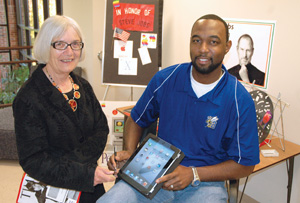
MSU BILLINGS NEWS SERVICES — Dr. Connie Landis and Steve Jobs never met. But his passion and her passion have been inseparable for more than two decades.
So when the Apple co-founder and technology icon died earlier this month, it only made sense for the Montana State University Billings art professor to set up a memorial to Jobs and the impact he had.
“I had to honor the man. After all, he’s affected us all so much,” Landis said.
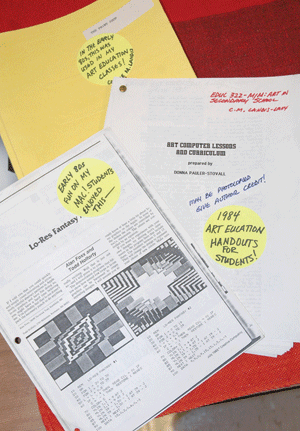
So she retrieved a few teaching documents saved from the early 1980s, when Jobs’ Macintosh computer first entered the world and programs were developed to do graphic art on a small black and white computer screen. She found some old magazines that featured Jobs and his “insanely great” ideas. She even brought in a small box that held an iMac mouse from the 1990s.
 She then put them on a table on the second floor of the College of Education building
at MSU Billings and invited others to provide items that reflected their own thoughts
on Jobs. In the past two weeks, colleagues have contributed Mac keyboards, Mac posters
and various Apple marketing materials. It has drawn various interest from students,
staff and faculty, many of whom share stories about becoming a Mac fan or an Apple
addict.
She then put them on a table on the second floor of the College of Education building
at MSU Billings and invited others to provide items that reflected their own thoughts
on Jobs. In the past two weeks, colleagues have contributed Mac keyboards, Mac posters
and various Apple marketing materials. It has drawn various interest from students,
staff and faculty, many of whom share stories about becoming a Mac fan or an Apple
addict.
Darrel Williams, a desktop support specialist at MSU Billings who carries an iPhone, an iPad and is a devoted Mac user, stopped by to visit with Landis Friday and talk about his experiences. Williams studied information system s at the University of Mary in North Dakota so he knows and works with all platforms and software. Yet when he talks about Jobs and his Apple products, Williams’ appreciation for technological beauty comes through.
As a geek, Jobs knew technology would change the world. As a visionary, Williams said, Jobs found a way for people to desire his products.
“He took technology to the next level so that it was actually pretty to look at as well as work with,” Williams said.
Landis’ connection to Apple and the Macintosh computer dates back to 1982. She was advancing her education at the University of Wisconsin in Madison and some of her colleagues were reviewing various lines of computer code that would allow someone to display various abstract art on a small computer. It was a precursor to the graphic user interface code that would put the power of computer-generated art in the hands of millions.
In 1983, Landis and a colleague had done enough work with the program that they were going to do a breakout discussion at a National Art Educators Association workshop. They were expecting two dozen curious art teachers. About 200 showed up.
It was that kind of thirst for new technology that personally affected people, Landis said, and it grew from there.
On college campuses, Jobs’ legacy is everywhere:
- Students have playlists of hundreds of songs their pockets and ears rather than in crates of albums in residence hall rooms.
- Notes in class can be taken on laptops in front of them in class rather than on notebook paper.
- A worldwide treasure trove of research documents can be found at a student’s fingertips 24 hours a day from home.
- Professors can connect to student emails on an iPhone from their offices when a question comes up instead of waiting for contact at the next class.
- Apps can be used as instant educational tools.
- Systems support can be handled on the run with the help of an iPad.
- And since none of Jobs’ innovations were singular, lessons abound on the benefits of creative collaboration.
Landis said she will leave the display up on the second-floor foyer area of the College of Education for two more weeks. It’s a fitting tribute, she said, to the innovative spirit of America.
“My personal heroes are of the ‘Steve Jobs type,’ not those glitzy celebrities and movie/TV stars,” she said. “This little project is weird/unusual to say the least, yet it might be a suitable memorial to an American who has impacted many folks.”
Any contributions related to Mac computers or Apple products can be added to the display at any time. Valuable items are NOT welcomed for security reasons. Any student, faculty member or staff member who wants to contribute can contact Landis at clandis@msubillings.edu or at 657-2981.
PHOTOS ABOVE: Dr. Connie Landis, left, a professor of art at MSU Billings, and Darrel Williams, a desktop support specialist with the information technology department, are devotees of Apple and Macintosh products. After Steve Jobs, Apple co-founder, died earlier this month, Landis put together a memorial display on the impacts of his work. Williams and others have contributed items to the display. Williams holds an iPad he uses every day in his work around the university. Below are some of the teaching tools Landis used when Macintosh computers were introduced to educators in the early 1980s.